The AI Revolution: 10 Ways Artificial Intelligence Will Change Business in 2026
Published • 4 Min Read
Artificial Intelligence (AI) is no longer just a technology for big companies. In 2026, businesses of all sizes are using AI to save time, understand customers, reduce costs, and make better decisions. From small startups to global companies, AI is becoming an important part of everyday business operations.
Here are 10 major ways AI will change business in 2026.
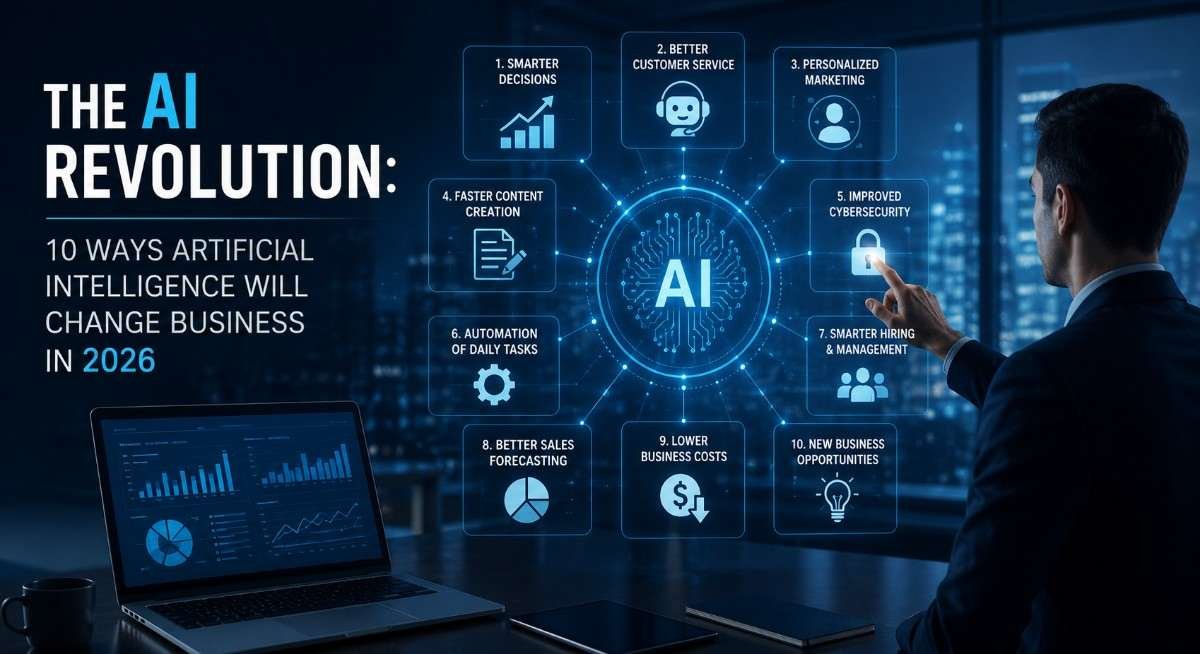
1. Smarter Business Decisions
AI can study large amounts of data much faster than humans. Businesses can use AI to understand sales, customer behavior, market trends, and financial information. This helps business owners make faster and more informed decisions instead of relying only on guesswork.
2. Better Customer Service
AI-powered chatbots and virtual assistants are making customer support faster. They can answer common questions, track orders, provide basic information, and work 24/7. Human employees can then focus on more difficult customer problems.
3. More Personalized Marketing
Customers expect brands to understand their needs. AI can study customer interests, shopping habits, and online activity to create more personalized marketing campaigns. Businesses can recommend products, send relevant offers, and create content for specific customer groups.
4. Faster Content Creation
AI is changing the way businesses create content. Companies can use AI tools to generate ideas, write drafts, create images, summarize information, and prepare social media content. This does not mean humans are no longer needed. Instead, AI helps teams complete creative work faster.
5. Improved Cybersecurity
Cyberattacks are becoming more advanced, so businesses need stronger security. AI can monitor systems, identify unusual activity, and detect possible threats quickly. In 2026, AI will help companies protect customer information and business data more effectively.
6. Automation of Daily Tasks
Many repetitive tasks can be automated with AI. This includes data entry, appointment scheduling, invoice processing, email sorting, and report creation. Automation allows employees to spend more time on creative, strategic, and customer-focused work.
7. Smarter Hiring and Employee Management
AI can help businesses manage parts of the recruitment process. It can organize resumes, identify relevant skills, schedule interviews, and help HR teams manage employee data. However, human judgment remains important when making final hiring and workplace decisions.
8. Better Sales Forecasting
Knowing what customers may buy in the future is valuable for every business. AI can study previous sales, seasonal trends, customer behavior, and market information to predict future demand. This can help companies manage inventory, pricing, and sales strategies.
9. Lower Business Costs
AI can help companies reduce unnecessary expenses by improving efficiency. Automated processes can reduce manual work, while better forecasting can help prevent excess inventory and wasted resources. For small businesses, these savings can make a significant difference.
10. New Business Opportunities
Perhaps the biggest impact of AI is the creation of new products and services. Businesses can use AI to develop smarter software, personalized services, automated tools, and innovative customer experiences. Entrepreneurs who understand AI can find new ways to solve problems and reach customers.
The Future of Business Is Human + AI
AI will not simply replace people. Instead, businesses that combine human creativity, experience, and decision-making with AI technology are likely to have an advantage. Employees will need to learn how to use AI tools effectively and responsibly.
Businesses should also pay attention to privacy, security, accuracy, and ethical use. AI works best when it supports people rather than replacing human responsibility completely.
Conclusion
The AI revolution is changing business in 2026 by making work faster, smarter, and more personalized. From customer service and marketing to cybersecurity and decision-making, AI is becoming part of almost every area of business.
Companies that start learning and using AI today can adapt more easily to future changes. The key is not simply to use AI because it is popular, but to use it where it creates real value for the business and its customers.