AI at Work: Which Jobs Will Change Most in the Next Five Years?
Published • 4 Min Read
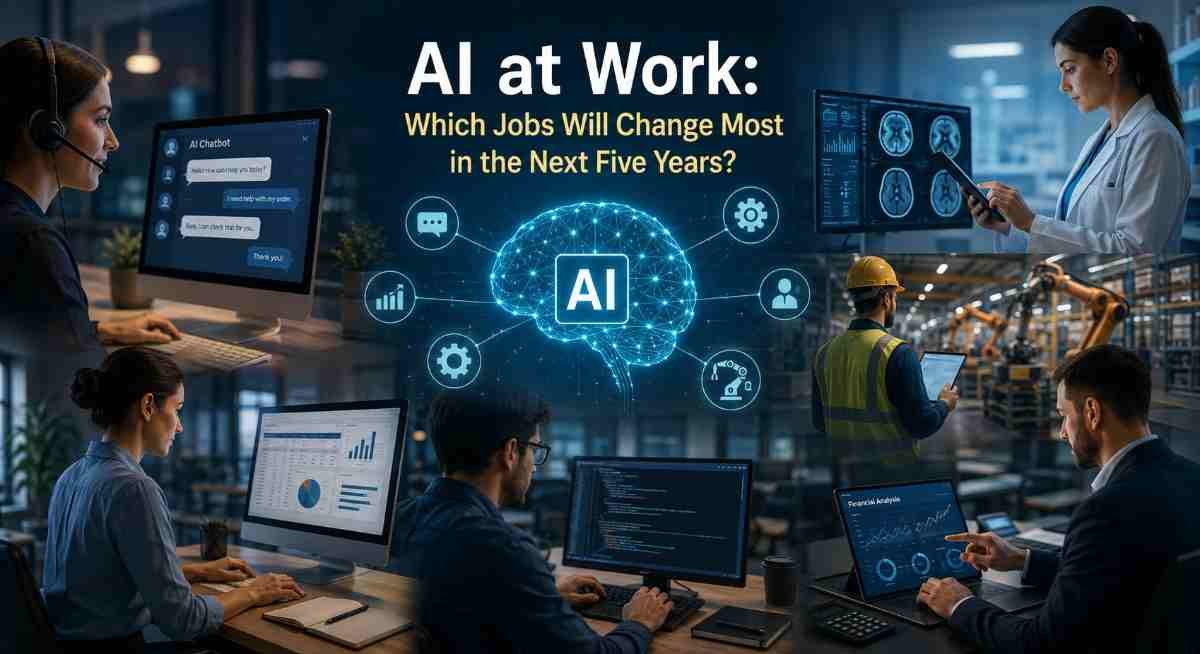
Artificial Intelligence is no longer a future idea. It is already changing the way people work, communicate, create, and solve problems. From chatbots and automated software to AI-powered design and data tools, technology is becoming a regular part of many workplaces. However, AI is not simply about replacing people. In many cases, it is changing job roles and creating new ways of working.
Over the next five years, some professions are likely to experience bigger changes than others. Let’s look at the jobs that may change the most and what workers can do to stay prepared.
1. Customer Service Jobs
Customer service is one of the areas where AI is already making a major impact. AI chatbots can answer common questions, track orders, provide basic support, and work 24/7.
This does not mean that human customer service workers will disappear completely. Instead, their roles may focus more on handling difficult problems, emotional situations, and complex customer needs. Human communication, patience, and problem-solving will remain important.
2. Administrative and Office Jobs
Many office workers spend time on repetitive tasks such as scheduling meetings, entering data, preparing reports, and managing emails. AI tools can now complete some of these tasks much faster.
As a result, administrative professionals may spend less time on routine work and more time on planning, coordination, decision-making, and communication. Workers who learn to use AI tools effectively may become more productive and valuable.
3. Marketing and Content Creation
Marketing professionals, writers, designers, and social media managers are also seeing big changes. AI can help create drafts, generate ideas, analyse customer data, design visuals, and automate campaigns.
However, AI cannot fully replace human creativity and understanding. Businesses still need people who understand their audience, build strong brand identities, and create original strategies. The future marketer may use AI as an assistant while focusing more on creative thinking and strategy.
4. Software and Technology Jobs
Technology jobs will change significantly because AI can now assist with coding, testing, debugging, and documentation. Developers may spend less time writing basic code and more time solving complex problems, designing systems, and checking AI-generated work.
At the same time, new opportunities are growing in areas such as AI development, cybersecurity, data science, and machine learning. According to the World Economic Forum, technology-related roles such as AI and machine learning specialists, big data specialists, and software developers are among the fastest-growing jobs expected toward 2030.
5. Healthcare Jobs
AI is becoming increasingly useful in healthcare. It can help doctors analyse medical information, identify patterns, manage records, and support diagnosis.
Still, healthcare depends heavily on human judgement, empathy, and direct patient care. Doctors, nurses, therapists, and other professionals may use AI to save time and improve efficiency rather than being completely replaced. Research on the changing AI job market also shows that human judgement and expertise are becoming increasingly valuable alongside AI tools.
6. Finance and Accounting Jobs
AI can process large amounts of financial data, identify unusual patterns, and automate routine accounting tasks. This means finance professionals may spend less time on basic calculations and data entry.
Instead, their work may move toward financial planning, risk analysis, business strategy, and advising clients. Human professionals will still be needed to make important decisions and understand complex business situations.
7. Manufacturing and Logistics Jobs
Factories, warehouses, and delivery systems are also likely to change because of AI and robotics. Machines can handle repetitive tasks, improve production, and help manage inventory.
Workers in these industries may need to learn how to operate, monitor, and maintain advanced technology. At the same time, jobs requiring physical skills, technical knowledge, and problem-solving will continue to be important as automation expands.
The Skills That Will Matter Most
The future workplace will not only require technical knowledge. Human skills will become even more important. Creativity, critical thinking, communication, leadership, adaptability, and problem-solving are expected to play a bigger role.
Recent research also shows that skills in AI-exposed jobs are changing faster, while employers are placing greater value on human abilities such as judgement, creativity, and leadership.
Conclusion
AI will change many jobs over the next five years, but change does not always mean job loss. In many industries, AI will automate certain tasks while creating new responsibilities and opportunities.
The best way to prepare is to stay open to learning. Workers who combine AI knowledge with strong human skills will be better positioned for the future.