How CEOs Can Build a Sustainable Business Growth Strategy
Published • 3 Min Read
Business growth is one of the most important aspects for CEOs, yet rapid growth does not mean sustainable growth. It is possible for companies to grow faster without becoming more profitable, efficient, and without increasing customer satisfaction.
Sustainable growth for CEOs is creating an environment in which their business can grow and maintain profitability, efficiency, client trust and stability.
Below are some approaches that CEOs can implement to develop a sustainable business growth strategy.
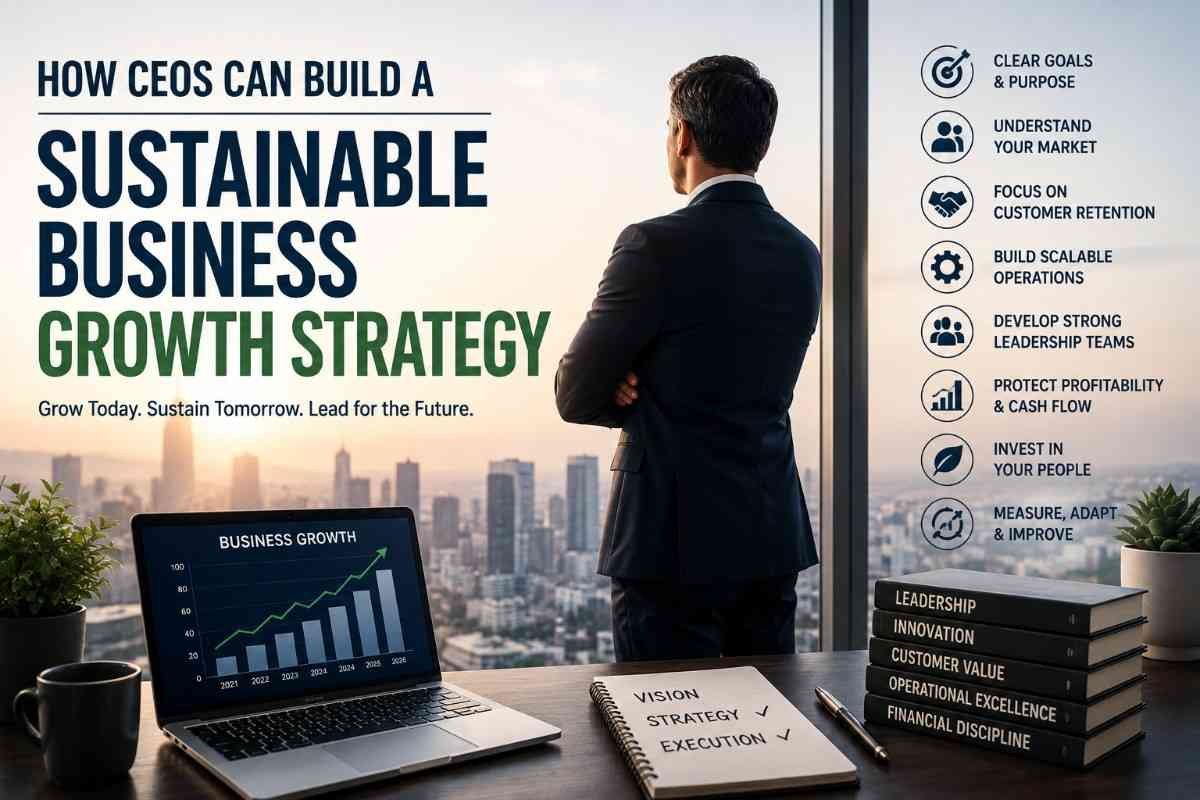
1. Setting up Growth Objectives
Every growth strategy needs to start with the right set of objectives.
The key to developing a growth strategy is knowing what success really means for the company, beyond just increasing revenue.
Some examples could be:
* Increased revenue
* Increased profits
* Expansion of the market share
* Increased customer retention
* Development of new products
* Increased efficiency
2. Know your target market
Sustainable growth requires knowledge about customers.
The CEOs need to make sure that the customer demands, market trends, the competition and demand changes are evaluated on a regular basis. A company that knows its market will be able to find new opportunities and not waste time on investments with low returns.
The customers’ feedback, sales results, market research and competitive analysis may help with making proper decisions.
3. Work on retaining your customers
Getting new customers may cost a lot of money. In some cases, retaining the current customers may serve as a good base for future growth.
The companies need to concentrate on providing value and making customer experience a pleasant one.
4. Ensure Scalable Operations
Expanding the business may highlight some shortcomings in the company's operational structure.
What works for a business of 20 people will not necessarily work for 200 people in the same business.
CEOs must thus be ready to develop scalable processes, effective communication, technology, and systems.
The idea is to ensure that expansion becomes more straightforward instead of adding complexity with each dollar gained.
5. Create Good Leadership Teams
There is no way that a CEO can control everything about a growing business.
Having a good leadership team makes it possible to spread out tasks into areas such as finance, operations, sales, marketing, technology, and human resource management.
Effective leaders need defined responsibilities and measurable goals with the same business goal in mind.
6. Safeguard Profitability and Cash Flow
Sales increase does not necessarily equate to sound finances.
A business can record higher sales amidst challenges of expenses and cash flow.
The CEO needs to watch out for the business' profitability, operations cost, cash flow, and customer acquisition costs.
Growth strategies should not just be determined by the expected revenue but also by whether the organization is capable of financing its growth.
7. Employee Investments
Employees are key players when it comes to sustaining growth.
A firm needs employees who possess the relevant competencies needed for the next level of growth.
Employee investments may include training, career development, engagement, and great work culture.
8. Measure and Adapt
Market dynamics, customer expectations, and competition will constantly shift.
This means that any business growth strategy must be able to evolve accordingly over time.
CEOs must keep an eye on their important performance metrics and be willing to change course if necessary.
Key metrics might include growth rate, profitability, customer retention, employee churn rate, customer acquisition costs, and productivity.
Conclusion
Sustainable growth in a business cannot be defined merely by boosting sales numbers. It must have a balanced focus on **customers, operations, finance, employees, leadership, and strategy**.