10 Key Technologies Shaping the Future of Fintech
Published October 26, 2026 • 4 Min Read
Financial services are changing faster than ever. A decade ago, fintech was largely associated with mobile payments and digital banking. Today, technology is reshaping almost every part of the financial system, from how people make payments to how banks assess risk, detect fraud and offer investment advice.
As digital adoption continues to grow, several technologies are emerging as major forces behind the next phase of fintech.
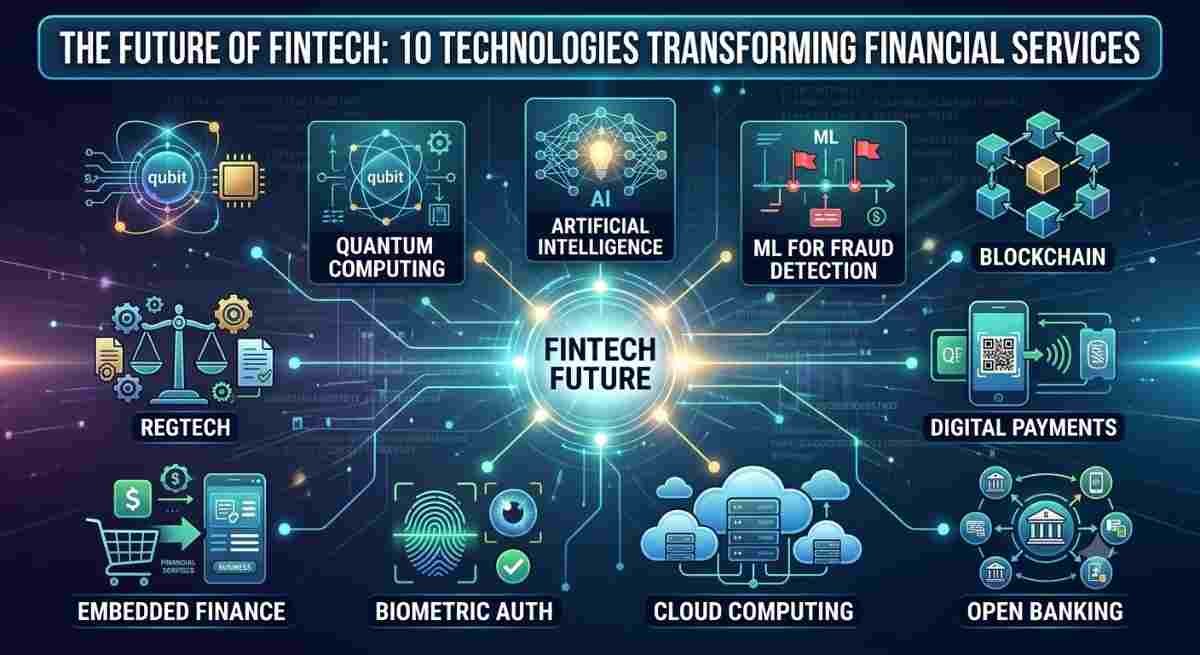
1. Artificial Intelligence
Artificial intelligence is becoming one of the most important technologies in financial services. Banks and fintech companies are using AI to analyse large amounts of data, identify unusual transactions, automate customer support and improve financial decision-making.
Generative AI is also beginning to change how customers interact with financial institutions, making it possible to provide more personalised and conversational services.
2. Machine Learning for Fraud Detection
Financial fraud is becoming more sophisticated, but so are the tools used to fight it. Machine learning systems can analyse transaction patterns and identify behaviour that may indicate fraud.
Unlike traditional rule-based systems, these models can continuously learn from new patterns, helping financial institutions respond to emerging threats more quickly.
3. Blockchain Technology
Blockchain is moving beyond its association with cryptocurrencies. Its ability to create transparent and tamper-resistant records has attracted interest across payments, settlement, trade finance and digital identity.
Tokenisation of real-world assets could also become an important area as financial institutions explore new ways of representing and transferring ownership digitally.
4. Digital Payments
Cashless payments have become a normal part of everyday life. Mobile wallets, instant bank transfers, QR payments and contactless transactions are making payments faster and more convenient.
The next stage is likely to focus on making payments more seamless, including transactions that happen in the background as part of digital platforms and connected services.
5. Open Banking
Open banking allows customers to securely share financial information with authorised third-party providers. This can give consumers access to more personalised financial products and make it easier for different financial services to work together.
For fintech companies, access to financial data can also support the development of budgeting tools, lending services and personalised financial management products.
6. Cloud Computing
Modern financial services depend on enormous amounts of data and computing power. Cloud technology allows financial institutions to scale their digital infrastructure without relying entirely on traditional physical systems.
It can also help banks launch products faster, improve flexibility and reduce some infrastructure costs, although security and regulatory compliance remain critical considerations.
7. Biometric Authentication
Passwords are increasingly being replaced or supported by technologies such as facial recognition, fingerprints and behavioural biometrics.
For financial institutions, stronger authentication can help reduce account takeovers while making digital banking more convenient for customers. The challenge will be balancing security with privacy and responsible use of personal data.
8. Embedded Finance
Financial services are increasingly becoming part of non-financial products. Customers may receive payment, lending, insurance or banking services directly inside shopping platforms, business software or other digital applications.
This trend could make financial services feel less like separate products and more like features built into everyday digital experiences.
9. RegTech
As financial regulations become more complex, technology is helping institutions manage compliance more efficiently. Regulatory technology, or RegTech, uses automation, analytics and AI to monitor transactions, manage reporting and identify potential compliance issues.
For financial companies, the goal is not simply faster compliance but better risk management.
10. Quantum Computing
Quantum computing is still an emerging technology, but financial institutions are already exploring its potential. In the long term, it could influence areas such as portfolio optimisation, risk modelling and complex financial calculations.
It could also create new cybersecurity challenges, particularly if existing encryption methods become vulnerable to more powerful computing systems.
What Comes Next?
The future of fintech is unlikely to be shaped by one technology alone. AI will work alongside cloud computing, blockchain, digital payments, cybersecurity and data-driven tools to create increasingly connected financial ecosystems.
For consumers, this could mean faster payments, more personalised services and greater access to financial products. For financial institutions, it will also mean adapting to new security risks, regulations and changing customer expectations.
The fintech companies that succeed may not necessarily be the ones with the most advanced technology. They could be the ones that use technology responsibly to solve real financial problems while earning the trust of the people who use their services.
In the coming years, technology will continue to change finance—but trust, security and customer experience will remain at the centre of that transformation.